Category: Sport

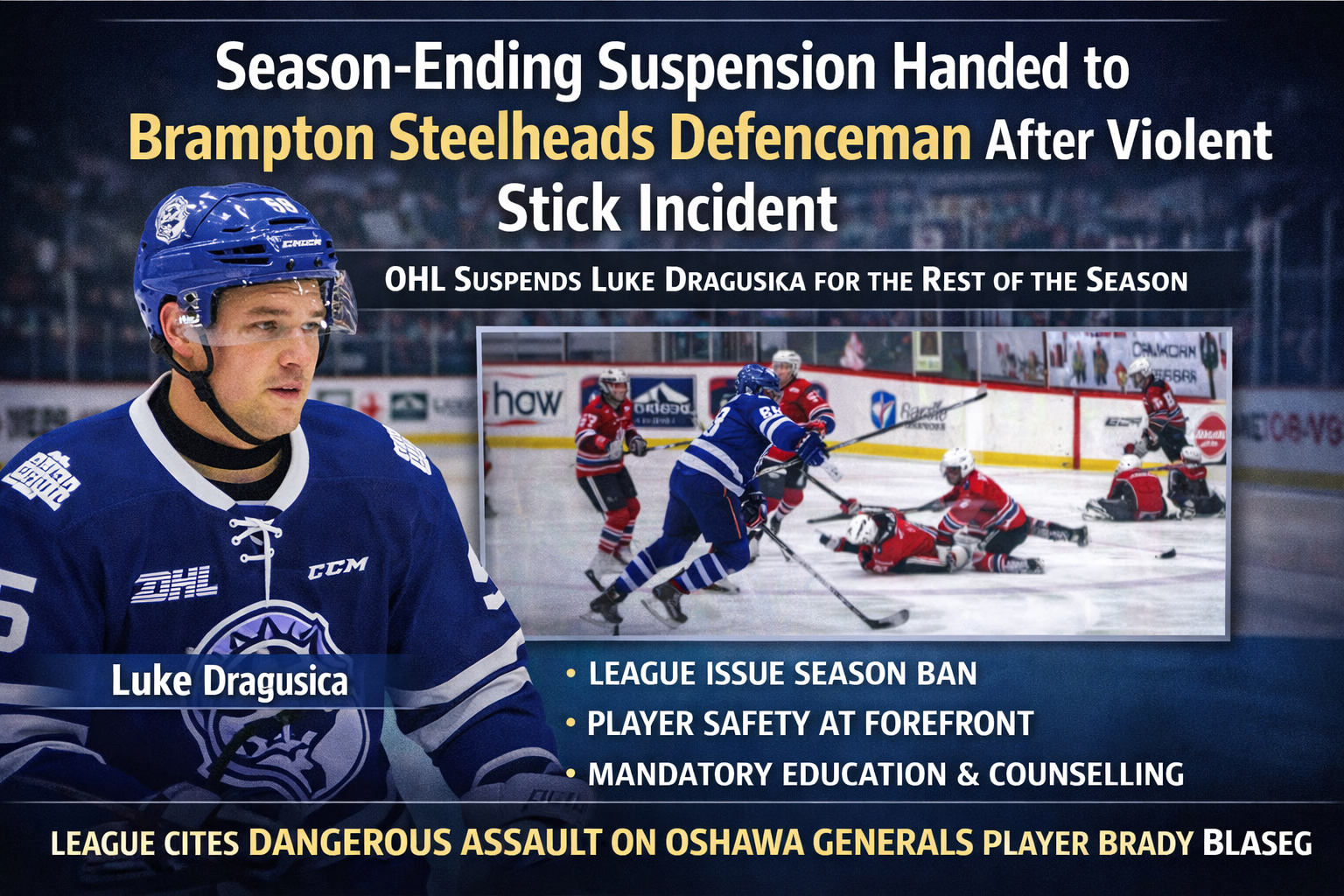
  • Season-Ending Suspension Handed to Brampton Steelheads Defenceman After Violent Stick Incident

    Season-Ending Suspension Handed to Brampton Steelheads Defenceman After Violent Stick Incident

    A single moment. A split-second decision. And a season—along with a reputation—now hangs in the balance.

    The Ontario Hockey League has delivered one of its most severe disciplinary rulings in recent memory, suspending a Brampton Steelheads player for the remainder of the season following a dangerous on-ice incident that crossed well beyond the accepted boundaries of the sport.

    The ruling sends a clear message. Skill is celebrated. Toughness is respected. Violence, especially of this nature, is not tolerated.

    Incident Triggers Swift League Response

    The suspension stems from a Nov. 14 matchup between the Brampton Steelheads and the Oshawa Generals, played at Oshawa’s CAA Centre.

    During the third period of the game, Brampton defenceman Luke Dragusica struck Oshawa forward Brady Blaseg in the head with his stick. The blow, delivered with force, immediately dropped Blaseg to the ice.

    Video footage reviewed by league officials shows Dragusica swinging his stick in a deliberate motion, making contact with the side of Blaseg’s head. As Blaseg fell, a second strike followed before nearby players rushed in, escalating the situation into a brief but intense confrontation.

    Moments later, a trainer sprinted onto the ice. That image alone told the story.

    OHL Issues Season-Ending Suspension

    One of the Harshest Penalties Available

    Following a detailed review, the Ontario Hockey League announced that Dragusica is suspended for the remainder of the regular season and the playoffs.

    That decision effectively ends his participation in the 2025–26 campaign.

    The league also imposed additional conditions. Dragusica must complete a mandatory program involving education, counselling, and community service. These requirements are not symbolic. They are prerequisites.

    Furthermore, Dragusica must appear before a reinstatement panel if he wishes to be considered eligible for the 2026–27 season.

    This is accountability, layered and deliberate.

    The League’s Broader Message

    Drawing a Firm Line on Player Safety

    The OHL has spent years reinforcing its stance on head contact and dangerous stick use. This ruling reinforces that commitment.

    Junior hockey walks a fine line. It’s fast. It’s physical. Emotions run hot. But there are limits.

    As former NHL coach Scotty Bowman once said, “Discipline isn’t about punishment. It’s about standards.” The league appears to agree.

    By acting decisively, officials underscored that protecting players—especially from head injuries—remains a non-negotiable priority.

    Details of the On-Ice Altercation

    What the Video Shows

    The incident unfolded quickly but left lasting consequences.

    As play continued in the third period, Dragusica and Blaseg became entangled near the boards. What might have ended with a shove or a whistle instead escalated. Dragusica lifted his stick and swung.

    Blaseg collapsed. Another strike followed. Players from Oshawa immediately intervened. Gloves dropped. Tempers flared.

    Officials ejected Dragusica from the game on the spot.

    A hush fell over the building as medical staff attended to Blaseg. Fans understand hard hockey. They also understand when something has gone too far.

    Injury Report Raises Serious Concerns

    Blaseg Receives Medical Treatment

    Reports following the game indicate that Blaseg suffered a cut across his mouth, facial bruising, and bleeding that required stitches. Additional medical evaluations are ongoing to determine whether further injuries occurred.

    Head injuries in hockey are never routine. They carry uncertainty. They linger.

    One veteran trainer, speaking generally about such incidents, once remarked, “You can ice a bruise. You can’t rush the brain.” That reality sits at the heart of the league’s decision.

    Impact on the Brampton Steelheads

    Losing a Defenceman—and Stability

    For the Steelheads, the loss is significant.

    Dragusica was a regular presence on the blue line, relied upon for minutes and physical play. His absence forces adjustments. Pairings change. Responsibilities shift.

    Coaches now face the challenge of maintaining competitive balance while addressing the emotional fallout of the incident.

    Teams don’t just lose players in suspensions. They lose rhythm.

    A Teachable Moment for Junior Hockey

    Beyond the Penalty Box

    The OHL’s mandated education and counselling component is designed to do more than discipline. It aims to prevent repetition.

    Junior hockey players are still developing—not just athletically, but personally. Mistakes happen. The question is whether lessons follow.

    A fictional but familiar locker-room scene comes to mind. A coach, arms crossed, pauses before speaking. “You don’t just represent yourself,” he says. “You represent this jersey.” Silence follows. The message lands.

    That’s the hope here.

    Reaction Across the League

    Players, Coaches, and Fans Take Note

    Reactions have been swift and varied.

    Some fans argue the punishment is severe. Others believe it’s overdue. Many agree on one thing: the video is difficult to watch.

    Coaches around the league have quietly acknowledged that the ruling sets a precedent. One assistant coach, speaking anonymously, noted, “This tells players there’s no grey area with sticks and heads.”

    And maybe that clarity is the point.

    What Happens Next for Dragusica

    The Road Back Is Conditional

    Dragusica’s future in the OHL is uncertain.

    Completion of the league’s programs is mandatory. A reinstatement hearing awaits if he seeks to return next season. Nothing is guaranteed.

    Reputation matters in hockey. So does growth.

    As author Maya Angelou famously wrote, “When you know better, you do better.” The league is giving Dragusica the opportunity to demonstrate that growth—off the ice first.

    Conclusion: A Defining Decision for the OHL

    This suspension is more than a disciplinary note buried in league records. It is a statement.

    The Ontario Hockey League has reaffirmed its commitment to player safety, accountability, and standards of conduct. The ruling serves as a warning, a lesson, and a reminder.

    Hockey is emotional. It is intense. It is unforgiving. But it must also be responsible.

    For Brady Blaseg, the focus remains on recovery. For the Brampton Steelheads, it’s adaptation. For Luke Dragusica, it’s reflection.
  • Inside a Defining and Divisive Era for Canada Basketball: Growth, Glory, and Allegations That Shaped the Game

    Inside a Defining and Divisive Era for Canada Basketball: Growth, Glory, and Allegations That Shaped the Game

    Canadian basketball’s rise to global prominence did not come without turbulence. Long before packed NBA arenas, Olympic medals, and international respect, the sport in Canada struggled with identity, recognition, and deep internal divisions. A pivotal moment came during the early 1990s, when ambition, opportunity, and controversy collided—leaving a lasting imprint on the national program.

    This article draws from an excerpt of “The Golden Generation: How Canada Became a Basketball Powerhouse” by Toronto-based journalist Oren Weisfeld, offering a closer look at a period marked by breakthrough success, painful scrutiny, and allegations of systemic bias that would shape Canada Basketball for decades.


    A Global Tournament Finds an Unlikely Home

    From War-Torn Europe to Canadian Arenas

    The 1994 FIBA World Championship was originally scheduled for Belgrade, Yugoslavia. However, the outbreak of civil war in the region forced international organizers to abandon the plan. Faced with the challenge of relocating one of basketball’s premier global events, FIBA president Boris Stankovic turned to Canadian businessman John Bitove to gauge Canada’s interest in hosting.

    For Bitove, the opportunity came with one non-negotiable condition: the participation of NBA players. Fresh off the historic 1992 Barcelona Olympics—where the U.S. “Dream Team” captivated the world—professional players had become central to basketball’s global appeal. Without that star power, Bitove believed the tournament would struggle to attract fans and sponsors.

    Securing NBA Approval and Hosting Rights

    Bitove reached out to then-NBA commissioner David Stern, who made it clear that professional players would only be allowed if the tournament was held in North America. That approval set the stage for an ambitious bid.

    A committee co-chaired by Bitove and Canada Basketball CEO Rick Traer raised $13 million to secure hosting rights. The 11-day tournament was staged across Toronto’s SkyDome, Maple Leaf Gardens, and Hamilton’s Copps Coliseum—an unprecedented undertaking for Canadian basketball.


    A Commercial and Cultural Breakthrough

    Record Attendance and Financial Survival

    The tournament proved to be a commercial success. Organizers sold a world championship record 332,334 tickets, including more than 32,000 seats for the gold medal game at the SkyDome. Canada Basketball, which had been operating on the brink of financial collapse, broke even weeks before tip-off and ultimately received 40 per cent of the profits.

    Those funds were instrumental in stabilizing the organization and ensuring its survival during a critical period.

    A Direct Path to the Toronto Raptors

    The ripple effects extended beyond the national program. Just one year later, Bitove leveraged the relationships he had built during the tournament to secure ownership of Canada’s first NBA franchise—the Toronto Raptors.

    Without hosting the 1994 world championship, Bitove later acknowledged, the Raptors may never have existed.


    Steve Nash Emerges, Expectations Falter

    A Young Star Takes the Stage

    For Canadian fans, the tournament also marked the international emergence of Steve Nash. At just 20 years old and competing in his first senior national tournament, Nash averaged seven points, three assists, three rebounds, and two steals per game.

    Initially, organizers and coaches had focused on freeing up Canada’s lone NBA player at the time, Rick Fox. Instead, Nash’s creativity and flair stole the spotlight, offering a glimpse of the future face of Canadian basketball.

    Disappointing Results at Home

    Despite Nash’s promise, Canada’s overall performance fell short. The team finished seventh out of 16 nations and failed to advance past the group stage after key losses to Russia and Greece. At home, the disappointment was magnified.

    Team USA’s “Dream Team II,” led by Shaquille O’Neal, dominated the tournament, winning gold with ease. Canada, meanwhile, faced criticism for failing to capitalize on the rare advantage of hosting on home soil.


    A Home Crowd That Didn’t Feel Like Home

    Fans Cheering for the Opposition

    Even more damaging than the losses was the atmosphere inside the arenas. Though games were well attended, it became clear that many fans were not there to support Canada. Matches against teams like Greece featured overwhelming displays of foreign flags, reflecting the deep-rooted immigrant communities in cities such as Toronto and Hamilton.

    Veteran observers described the scene as embarrassing, noting the lack of visible national support during a defining moment for the program.

    A Sport Still on the Margins

    At the time, basketball remained a niche sport in Canada. Former national team players recalled being recognized internationally while remaining anonymous at home. The arrival of NBA franchises in Toronto and Vancouver was still a year away, and mainstream attention remained elusive.


    A Deeper Problem Beneath the Surface

    Coaching Philosophy and Centralized Control

    Beyond public perception, internal tensions were brewing. Head coach Ken Shields had centralized the national team program in Victoria, British Columbia, relying heavily on U Sports athletes from the West Coast—many of whom he had previously coached to success at the University of Victoria.

    The system emphasized discipline, fitness, and structured half-court play. While effective at the university level, critics argued it failed to reflect the evolving style of Canadian basketball.

    East Coast Talent and Cultural Divide

    During the same period, basketball power in Canada was shifting eastward. Diverse, urban centers like Toronto and Montreal were producing dynamic players shaped by streetball culture—faster, more creative, and often more individualistic.

    Many Black athletes from these communities believed they were marginalized by a system that favored players trained together in Victoria. The location itself was also described as unwelcoming for players from racialized backgrounds.


    Allegations of Racial Bias Emerge

    High-Profile Players Speak Out

    The controversy reached a boiling point when prominent players such as Cordell Llewellyn and Wayne Yearwood were cut from the national team ahead of the 1994 tournament. Both had strong resumes, including NCAA experience and prior national team appearances.

    They publicly alleged that racial bias influenced selection decisions, arguing that Black players were stereotyped as having “attitude” rather than leadership qualities.

    Media Investigation and Public Fallout

    A Globe and Mail investigation amplified the issue, publishing claims that Canada Basketball had systematically excluded Black players from Toronto. The story ignited national debate and forced the organization into damage-control mode.


    Review, Retraction, and Reform

    External Investigation Findings

    Canada Basketball commissioned an independent review led by Sport Canada. After interviewing dozens of individuals, the report concluded that race did not influence team selection. The Globe and Mail later issued a retraction, and Shields pursued legal action, which was settled out of court.

    However, the review did not absolve the program entirely. It issued 11 recommendations, including structural changes, expanded tryouts across the country, and greater inclusion of minority coaches.

    A Reputation That Lingered

    Despite official findings, the damage to Canada Basketball’s reputation endured. Many players of colour remained skeptical of the national program well into the 2000s, shaping perceptions for an entire generation.


    Conclusion: A Painful Chapter That Shaped the Future

    The 1994 FIBA World Championship was both a breakthrough and a reckoning for Canada Basketball. It delivered financial stability, international exposure, and laid the groundwork for the NBA’s arrival in Canada. At the same time, it exposed cultural divides, systemic shortcomings, and unresolved questions about equity and representation.

  • Inside a Defining and Difficult Era for Canada Basketball

    Inside a Defining and Difficult Era for Canada Basketball

    Long before packed NBA arenas, global superstars, and Olympic medal dreams became part of Canada’s basketball identity, the sport in this country existed on the margins—underfunded, overlooked, and deeply divided. The early 1990s represented both a turning point and a painful reckoning for Canada Basketball, as ambition collided with reality during a period marked by growth, missteps, and uncomfortable truths.

    At the centre of this turbulent era was the 1994 FIBA World Championship, an event that was supposed to announce Canada’s arrival on the global basketball stage. Instead, it exposed structural weaknesses, cultural fractures, and longstanding issues that would take decades to confront.


    How Canada Ended Up Hosting the World

    The tournament was never meant to come to Canada. Originally scheduled for Belgrade, the championship was relocated after war broke out in Yugoslavia in the early 1990s. With limited options available, FIBA reached out to Canadian businessman John Bitove, asking whether Canada could step in.

    Bitove saw opportunity—but only if the event carried global relevance. The success of the 1992 Barcelona Olympics, where NBA professionals formed the iconic U.S. Dream Team, had transformed basketball’s international appeal. Bitove believed Canada could not attract fans, sponsors, or legitimacy without NBA participation.

    After securing approval from NBA commissioner David Stern, Canada won the bid. A committee raised roughly $13 million to stage the tournament across Toronto and Hamilton, using massive venues like SkyDome and Maple Leaf Gardens.

    Against the odds, the event was a commercial success. Hundreds of thousands of tickets were sold, and Canada Basketball—an organization on the brink of financial collapse—received a share of the profits that ensured its survival.

    The ripple effects were historic. Within a year, Bitove leveraged those relationships to help bring the Toronto Raptors into existence. In many ways, the world championship laid the foundation for Canada’s NBA future.


    A Young Star Emerges

    On the court, the tournament marked the first major international moment for a 20-year-old Steve Nash. Playing in his first senior event, Nash showed flashes of creativity and confidence that hinted at what was to come.

    Though he was not yet a star, his style stood out. While much of the roster focused on structure and discipline, Nash brought flair, vision, and unpredictability—qualities that would later define Canadian basketball’s modern identity.

    Despite that promise, Canada’s performance disappointed. The team finished seventh, failing to reach the quarterfinals on home soil. Losses to teams like Russia and Greece fueled criticism and amplified scrutiny.

    For many observers, the problem was not effort, but identity.


    An Embarrassing Atmosphere at Home

    One of the most uncomfortable moments of the tournament had little to do with the scoreboard.

    In several games, Canadian fans were visibly outnumbered by supporters of opposing teams. Flags from Greece, Russia, and other nations filled the stands, creating a jarring scene for a host country. The lack of home support became a national talking point.

    For longtime basketball observers, it symbolized how disconnected Canada was from its own national program. Basketball simply did not command the attention hockey did, and without an NBA presence, the sport struggled to capture mainstream interest.

    Players noticed the difference immediately. Some recalled being recognized and celebrated overseas, only to be virtually anonymous at home. The contrast was stark—and demoralizing.


    A System Built on Control, Not Creativity

    Behind the scenes, deeper issues were unfolding.

    Head coach Ken Shields ran a centralized national team program based in Victoria, heavily influenced by his success coaching university basketball. His philosophy prioritized discipline, fitness, and execution. It worked in a limited context, producing solid teams and professional opportunities for some players.

    But it also narrowed the pipeline.

    The roster was dominated by athletes from Western Canada and university programs, while emerging talent from Toronto and Montreal—cities experiencing explosive growth in Black and immigrant communities—was often overlooked.

    Former coaches and players later described the teams of that era as overwhelmingly white, reflecting not just demographics but selection bias. While basketball culture was evolving rapidly in urban centres, the national program remained rooted in an older model.


    East vs. West: A Cultural Divide

    By the early 1990s, basketball power in Canada was shifting eastward.

    Toronto and Montreal high schools were producing athletes with speed, creativity, and an improvisational style influenced by streetball and outdoor courts. These players played above the rim, thrived in chaos, and brought flair to the game.

    It was a sharp contrast to the structured, methodical approach favoured by the national program.

    The divide wasn’t just tactical—it was cultural. Urban players often felt misunderstood or undervalued, while selectors viewed their style as risky or undisciplined. This disconnect prevented Canada from fully tapping into its growing talent base at a critical moment.


    Allegations and Uncomfortable Questions

    As years passed, former players and coaches became more vocal about the racial dynamics of that era.

    Some described systemic barriers that limited opportunities for Black athletes, not through overt exclusion, but through preferences that favoured certain backgrounds, coaching trees, and playing styles. Others pointed to a lack of diversity in leadership roles and decision-making positions.

    These conversations were largely absent from public discourse at the time. Basketball did not yet command enough national attention to force accountability. But the consequences were clear: Canada lagged behind countries that embraced change faster.


    Seeds of the Golden Generation

    Ironically, the very failures of the early 1990s planted the seeds for future success.

    The arrival of the Raptors and Vancouver Grizzlies in 1995 transformed basketball’s visibility. Young players finally had role models wearing Canadian jerseys in the NBA. Urban courts became incubators of talent rather than afterthoughts.

    Steve Nash’s eventual rise to MVP status reframed what Canadian basketball could be. His success challenged old assumptions and proved that creativity and intelligence could coexist at the highest level.

    Over time, Canada Basketball began to modernize—slowly expanding its talent identification, diversifying leadership, and embracing the country’s changing demographics.


    A Necessary Reckoning

    Looking back, the 1994 FIBA World Championship stands as both a triumph and a cautionary tale.

    It saved an organization financially, sparked the birth of an NBA franchise, and introduced a generation to international basketball. But it also revealed how unprepared Canada was to fully support, represent, and understand its own players.

    The embarrassment, the criticism, and the internal conflicts forced a long-overdue reckoning—one that would eventually shape the inclusive, globally respected program Canada boasts today.

    The golden generation did not emerge overnight. It was forged through missteps, missed opportunities, and difficult conversations that began during one of the most turbulent periods in the sport’s history.

  • Inside a Defining Era for Canada Basketball: Controversy, Cultural Shifts, and the Road to Reinvention

    Inside a Defining Era for Canada Basketball: Controversy, Cultural Shifts, and the Road to Reinvention

    Introduction: A Program at a Crossroads

    Canada Basketball did not become a global basketball force overnight. Its rise was shaped by moments of triumph, missteps, cultural tensions, institutional decisions, and an evolving national identity. The mid-1990s, often remembered for the arrival of the Toronto Raptors and the blossoming of Steve Nash, also represented one of the most turbulent eras in the program’s history.

    That period—marked by allegations of racial bias, internal fractures, and a rapidly changing basketball landscape—formed the backbone of a transformation that would ultimately reshape the sport in Canada. This rewritten report traces the events described in The Golden Generation: How Canada Became a Basketball Powerhouse, offering an in-depth look at the turning points that pushed the program toward accountability and change.

    A Tournament That Changed Everything

    Hosting the 1994 FIBA World Championship

    The 1994 FIBA World Championship was never meant to be held in Canada. Belgrade, Serbia, had originally secured hosting rights, but Yugoslavia’s civil war forced FIBA to reopen the bidding process. That’s when Canadian businessman John Bitove received a call from FIBA head Boris Stankovic asking whether Canada might step in.

    Bitove agreed on one condition: NBA players had to be allowed to participate. That decision was directly inspired by the enormous success of the 1992 Barcelona Olympics, which introduced the world to the U.S. Dream Team—Michael Jordan, Magic Johnson, Larry Bird, and other NBA stars who redefined basketball as a global spectacle.

    To make his case, Bitove contacted NBA commissioner David Stern. Stern’s response was clear: professional players would participate only if the tournament were held in North America. With that, Bitove joined forces with Canada Basketball CEO Rick Traer, raising $13 million to win the hosting bid.

    Their gamble paid off. More than 330,000 tickets were sold—an event record—and the gold-medal game at Toronto’s SkyDome attracted 32,000 fans. Canada Basketball even secured 40 per cent of the profits, revenue that kept the financially strained organization afloat.

    The Raptors Connection

    The success of the tournament gave Bitove the credibility he needed to pursue an NBA expansion franchise. One year later, in 1993, he became the founding owner of the Toronto Raptors. As he later acknowledged, “Without the ’94 worlds, I wouldn’t have had the NBA team.”

    The Arrival of Steve Nash

    A Young Guard Steals the Spotlight

    The tournament also marked the international debut of a rising star: 20-year-old Steve Nash. Though the team’s focus had initially been on showcasing Rick Fox, then Canada’s only NBA player, Nash’s playmaking quickly became the talk of the competition. His average of seven points, three assists, three rebounds, and two steals in 23 minutes per game hinted at the potential of a future MVP.

    But even Nash’s emergence could not mask the team’s struggles. Canada finished seventh in the 16-team field, falling short of expectations in front of a home crowd hungry for a breakthrough. Journalists called the performance disappointing, and missing the quarterfinals amplified the criticism.

    Fan Disengagement and Cultural Realities

    Cheering for the Opposition

    Despite strong attendance numbers, something unusual happened throughout Canada’s games: the cheers were louder for opposing teams. A notable matchup against Greece drew far more Greek flags than Canadian ones, prompting broadcaster Don Cherry to deliver one of his trademark rants about Canadian crowd loyalty.

    For many players, however, the phenomenon made sense. Toronto, Hamilton, and Montreal were home to large immigrant communities with deep basketball traditions. Supporters turned out in droves to cheer for their countries of origin, a reflection of Canadian multiculturalism. Yet for national team veterans like Doug Smith, it was jarring. He called it “one of the most embarrassing sports events I’ve ever been at.”

    Basketball’s Fight for Respect

    The lack of mainstream support was not new. Before the Raptors and Vancouver Grizzlies arrived in 1995, basketball remained fringe in many parts of the country. Players like Jay Triano and Eli Pasquale often said they were recognized internationally but ignored at home. During the 1986 world championship in Madrid, they were chased into stores by fans seeking autographs. Weeks earlier in Ottawa, a bar bouncer refused them entry—unaware they were national team athletes.

    Coaching Philosophy and a Brewing Divide

    Ken Shields and the Victoria-Centred System

    Beneath the surface, deeper tensions were forming around head coach Ken Shields’ approach. When Shields took over in 1989, he centralized the national program in Victoria, British Columbia, relying heavily on his network and the training infrastructure he built there. Players lived year-round in Victoria, trained full-time, and adopted a methodical, half-court style inspired by John Wooden.

    This system produced disciplined teams but clashed with the evolving demographics of Canadian basketball. A surge of talent was emerging from Toronto and Montreal—players influenced by outdoor court culture, fast-paced streetball, and a more improvisational style. Many of these athletes believed Shields’ system not only failed to highlight their strengths but created barriers to making the national team.

    Allegations of Racial Bias

    By the mid-1990s, frustration reached a boiling point. In 1994, the Globe and Mail published an explosive article titled Toronto Blacks Assail Basketball Canada, featuring allegations that Shields’ roster decisions were influenced by racial bias.

    Two standout players—Cordell Llewellyn and Wayne Yearwood—claimed they were cut not for performance reasons but because of preconceived notions about Black athletes. Llewellyn argued that the national team appeared to associate “Canada” with whiteness, while Yearwood criticized Shields’ inability to understand or fully utilize the talent available.

    The article triggered public outrage and prompted Canada Basketball to request an external review led by diplomat Cal Best and overseen by Sport Canada.

    The Review and Its Aftermath

    Findings and Recommendations

    The investigation interviewed more than 60 people. Ultimately, the report concluded that race did not play a role in team selection. However, it issued 11 significant recommendations aimed at modernizing the program, including:

    • separating the roles of coach and program director

    • recruiting more minority coaches

    • creating broader open tryouts across Canada

    Shields later sued the Globe and Mail, which settled and issued a retraction. He described the ordeal as deeply painful.

    Long-Term Impact

    Although the review cleared Shields of racism, it highlighted structural deficiencies within Canada Basketball—deficiencies many players felt disproportionately affected Black athletes. These concerns resurfaced repeatedly into the 21st century, revealing a lingering distrust rooted not in one individual’s actions but in decades of institutional culture.

    Conclusion: A Complicated Legacy

    The turbulent era of the early 1990s left a lasting imprint on Canada Basketball. The hosting of the 1994 FIBA World Championship sparked national interest, helped launch the Raptors, and introduced Steve Nash to a global audience. Yet behind the scenes, cultural divides, allegations of systemic bias, and shifting demographic realities forced the organization to confront its shortcomings.

    Today, the program features diverse leadership, transparent selection processes, and rosters built purely on merit. But the legacy of that difficult chapter remains part of the sport’s history—an essential reminder of how far Canada Basketball has come and how much was learned along the way.

  • A Look Back at the Growing Pains Behind Canada’s Rise as a Basketball Power

    A Look Back at the Growing Pains Behind Canada’s Rise as a Basketball Power

    For decades, Canada Basketball struggled to define its identity, reconcile regional differences and build a program capable of competing against the world’s best. Today, with NBA-level talent flooding the national roster and Canadian players shaping global basketball culture, it is easy to forget the turbulent years that nearly fractured the program from within.

    Throughout the 1980s and 1990s, systemic challenges — including allegations of racial bias, philosophical disputes over player development and the widening divide between East Coast and West Coast basketball cultures — created a volatile environment that shaped the organization’s future. Against the backdrop of immigration-driven demographic change and the growing influence of the NBA, these tensions exposed deep flaws in the national team structure and led to reforms that continue to influence the sport today.

    A Country New to Its Own Basketball Identity

    Basketball in Canada Before the Raptors Era

    Before Canada gained an NBA foothold with the Toronto Raptors and Vancouver Grizzlies in 1995, basketball remained a niche interest with minimal media attention. The sport, though invented by Canadian James Naismith, lacked the broad national support enjoyed by hockey or even football.

    University programs in Western Canada — particularly the University of Victoria under coach Ken Shields — dominated the domestic scene. Their structured, disciplined approach became the foundation of the national team program. But this philosophy did not reflect the rapidly evolving basketball culture in major urban centres.

    The Rise of Urban Talent

    Through the 1980s and early 1990s, Toronto and Montreal emerged as new basketball hotbeds. Immigration from the Caribbean, Africa and Latin America brought dynamic playing styles, outdoor-court creativity and a deep cultural connection to the global game.

    These communities produced some of the country’s most talented players. Yet many young stars felt overlooked by a national team system rooted primarily in the West Coast university model.

    This cultural disconnect would soon explode into a national controversy.

    International Pressure Exposes Internal Tensions

    The Early 1990s: A Critical Moment

    Internationally, the basketball world was changing fast. The arrival of NBA professionals at global events — first at the 1992 Barcelona Olympics with the famous U.S. “Dream Team” — dramatically shifted public interest and raised expectations for national programs.

    Canada, eager to be taken seriously, attempted to modernize but faced internal constraints:

    • limited funding

    • fragmented development pathways

    • competing regional philosophies

    • pressure from FIBA to grow the sport domestically

    By the mid-1990s, Canada Basketball was facing financial strain while fielding rosters that struggled to keep pace with global competition. The gap between the talent emerging in the country’s major cities and the players selected for the national team drew increasing scrutiny.

    Allegations of Racial Bias Surface

    Frustration Among Urban Players

    As more Black Canadian athletes emerged from Toronto, Montreal and other urban centres, some began to question whether they were being given fair opportunities. While these athletes excelled in NCAA programs and international leagues, several high-profile players claimed that they were being excluded from the national team for non-performance reasons.

    Many athletes argued that the system in place inadvertently favored:

    • players from the West Coast

    • university athletes familiar with the national team’s established system

    • a style of play emphasizing structure over improvisation

    This created the perception that Canada Basketball was culturally out of touch with the country’s evolving talent landscape.

    Media Spotlight Amplifies the Issue

    By the mid-1990s, the concerns of overlooked players gained significant media attention. Journalists began investigating whether systemic biases — intentional or not — were shaping roster decisions.

    The controversy put immense pressure on the national federation, which at the time lacked diversity in leadership and coaching roles. The public debate forced Canadians to confront the racial and structural inequities embedded in the country’s basketball ecosystem.

    External Review and the Push for Change

    A Federal Review Is Launched

    Facing public criticism, Canada Basketball requested an external review conducted through Sport Canada. The goal was to assess whether racial bias influenced selection decisions or team management.

    Though the investigation did not conclude that racism explicitly determined roster choices, it identified several structural issues:

    • lack of diversity on coaching staffs and selection committees

    • poor outreach to urban communities

    • training camps geographically concentrated in the West

    • outdated talent identification methods

    • limited transparency in the selection process

    The review offered a series of recommendations that would eventually reshape the national program.

    Key Changes Suggested by the Report

    Among its recommendations, the federal review emphasized:

    • separating coaching duties from administrative leadership roles

    • involving more minority coaches in certification and development pathways

    • expanding open tryouts across major Canadian cities

    • modernizing the style of play to reflect emerging talent

    • improving communication with urban athletes and their communities

    These reforms marked a turning point, acknowledging that Canada’s basketball identity was no longer regional — it was national, multicultural and dynamic.

    The Cultural Divide: Style, Philosophy and Identity

    The Clash Between Systems

    The West Coast university-based system was known for:

    • half-court execution

    • structure and discipline

    • traditional roles

    • low-risk, methodical offense

    Urban players, influenced by pickup culture and international styles, brought:

    • improvisation

    • athleticism and above-the-rim play

    • creativity and flair

    • speed and physicality

    This clash raised important questions:
    Which style best represented Canada? Which style produced the best teams?

    Evolving Toward a National Vision

    Over time, it became clear that Canada needed to integrate multiple basketball cultures rather than choose one. The country’s emerging stars — many of whom grew up on city courts — would eventually prove that embracing stylistic diversity was not a liability but a competitive advantage.

    A Program Reinvented

    The Long Road Toward Inclusivity

    The fallout from the 1990s controversy forced Canada Basketball to confront its shortcomings. In the decades that followed, the organization invested heavily in:

    • diversifying leadership

    • modernizing talent pathways

    • building national training centres

    • expanding youth development programs

    • strengthening ties with grassroots and community organizations

    Today, the majority of Canada’s elite players come from diverse, urban backgrounds — a reflection of the country’s demographic reality and its basketball renaissance.

    The Rise of a New Generation

    The success of players like Steve Nash, Jamaal Magloire, Tristan Thompson, Andrew Wiggins, Shai Gilgeous-Alexander and many others underscores the transformation of Canadian basketball culture. Many of these athletes grew up hearing stories about the national program’s past barriers — and their success helped ensure those issues would not define the future.

    Conclusion: A Complicated History, A Stronger Future

    Canada’s basketball journey has been marked by tension, transformation and hard-earned growth. The controversies of the 1980s and 1990s revealed painful truths about exclusion, regional bias and cultural misunderstanding. But they also pushed the organization toward reform, inclusion and modernization.

    Today, Canada is considered one of the most promising basketball nations in the world. Its rise is not only a product of talent but of the lessons learned during a turbulent era — one that reshaped the sport’s identity, redefined its values and cleared the path for a new generation.

  • Inside a Turbulent Era for Canada Basketball: Raptors Roots, Controversy, and Allegations of Racism

    Inside a Turbulent Era for Canada Basketball: Raptors Roots, Controversy, and Allegations of Racism

    Introduction

    Canada Basketball, today celebrated as a powerhouse on the global stage, endured a period of turbulence in the 1990s marked by organizational growing pains, missed opportunities, and controversial allegations of racial bias. An excerpt from Toronto-based journalist Oren Weisfeld’s new book, “The Golden Generation: How Canada Became a Basketball Powerhouse”, chronicles the organization’s evolution from obscurity to prominence, highlighting pivotal moments that shaped Canadian basketball’s identity — both on and off the court.

    From the country’s bold hosting of the 1994 FIBA World Championship to the rise of future NBA stars and deeply rooted controversies surrounding team selection, the era illustrates the complexities of a national program striving for global recognition.


    The 1994 FIBA World Championship: A Turning Point

    Canada Steps In as Host

    Originally slated to take place in Belgrade, Serbia, the 1994 FIBA World Championship was forced to relocate after the outbreak of civil war in Yugoslavia in 1991. Boris Stankovic, FIBA’s head, reached out to Canadian businessman John Bitove to gauge whether Canada could host the tournament. Recognizing the opportunity, Bitove insisted that the event would only be worth pursuing if NBA players were permitted to compete, ensuring fan interest and media attention.

    The success of the 1992 Barcelona Olympics, where the U.S. Dream Team — featuring legends like Michael Jordan and Magic Johnson — captivated global audiences, underscored the importance of professional talent in drawing fans. Securing NBA participation, Bitove collaborated with Canada Basketball CEO Rick Traer to raise $13 million and successfully host the 11-day tournament across Toronto’s SkyDome, Maple Leaf Gardens, and Hamilton’s Copps Coliseum.

    Record Attendance and Financial Success

    The championship set a world record for ticket sales, with 332,334 spectators attending games, including 32,000 for the gold medal match. The event not only broke even financially but also generated a 40 percent profit for Canada Basketball, stabilizing an organization previously on the brink of collapse. One year later, Bitove leveraged his connections and experience to become the founding owner of the Toronto Raptors, underscoring the championship’s long-term influence on Canadian basketball.

    Steve Nash Emerges

    The tournament also marked the international debut of a 20-year-old Steve Nash, who impressed despite Canada finishing seventh in a 16-team field. “We spent all our time trying to get Rick Fox freed up to play,” Bitove recalled. “Lo and behold, Steve Nash stole the show.”

    Despite Nash’s emergence, Canada’s seventh-place finish, combined with media criticism and a lack of genuine fan support, highlighted the challenges facing the sport in the country. Many fans attended games to support other national teams rather than Canada, reflecting both Canada’s multicultural population and the relative niche status of basketball at the time.


    Structural Challenges and Allegations of Racial Bias

    A West Coast-Centric System

    The national team, led by head coach Ken Shields, primarily drew players from the West Coast and U Sports programs. Shields’ methodical, inside-out offensive style emphasized discipline and fitness but often overlooked the speed, creativity, and improvisational talent of inner-city players from Toronto and Montreal, who had developed their skills in urban streetball environments.

    Former assistant coach Eddie Pomykala noted, “Let’s be honest: the national teams were white teams.” Only five Black players were on the roster, highlighting a lack of representation that would spark later allegations of systemic bias.

    Marginalization of Black Players

    Concerns intensified when top-tier players such as Cordell Llewellyn and Wayne Yearwood were cut ahead of the 1994 championship, despite proven talent and prior national team experience. Llewellyn claimed, “They have a preconceived opinion of Black players. It’s not my game that got me cut; it’s because they think if you have Canada written across your chest, you have to be white.”

    Yearwood echoed these sentiments, describing cultural misunderstandings and perceived stereotypes that influenced team selection. Former journalists and board members later documented similar complaints, revealing tension between Canada Basketball’s administration and players from diverse urban communities.


    Media Scrutiny and Institutional Response

    Globe and Mail Exposé

    Shortly after the tournament, the Globe and Mail published a story highlighting the exclusion of Black players from Toronto and alleging that Canada Basketball systematically favored white athletes. The resulting controversy prompted Canada Basketball to commission an independent review led by Caribbean-Canadian diplomat Cal Best.

    The review, which included interviews with over 60 individuals, concluded that race did not officially influence team selection. Shields also successfully sued the newspaper for defamation, leading to a retraction. However, the investigation recommended reforms, such as splitting the roles of head coach and program director, increasing minority coach participation, and expanding open tryouts nationwide.

    Lasting Impact

    While the review absolved Shields personally, it exposed deeper organizational shortcomings and a culture resistant to diversity and urban basketball styles. Freelance journalist Laura Robinson noted that systemic issues, including lack of representation and oversight by out-of-touch board members, hindered equitable development opportunities for players of color.


    Legacy: Growth Amid Controversy

    Bridging the Gap Between East and West

    Despite the setbacks of the 1990s, Canada Basketball evolved over the following decades. The arrival of NBA franchises — the Toronto Raptors and Vancouver Grizzlies — helped popularize the sport domestically. Urban players from Toronto and Montreal increasingly entered the NCAA and professional leagues, enriching the national talent pool.

    Modern-Day Inclusivity

    Today, Canada Basketball is recognized for selecting the best players regardless of race or geography. Black executives occupy leadership roles, and the program prioritizes inclusivity and meritocracy. Yet, as Oren Weisfeld notes, the shadow of earlier allegations lingered for years, shaping public perceptions and the aspirations of young athletes across the country.


    Conclusion

    The 1990s were a defining, if turbulent, period for Canadian basketball. From hosting the FIBA World Championship and launching the Raptors to grappling with allegations of racial bias, the era revealed both the promise and the shortcomings of the national program.

    Players, coaches, and journalists alike witnessed a system in transition — one striving to compete internationally while reconciling internal cultural and structural biases. The lessons learned during this time ultimately laid the foundation for Canada’s modern success, shaping a national basketball identity that is increasingly diverse, competitive, and globally respected.

    While controversy and missteps were abundant, the period remains a crucial chapter in the country’s journey to becoming a basketball powerhouse. It underscores the importance of inclusivity, transparency, and adaptability in building a program capable of nurturing talent from coast to coast.

  • Inside a Turbulent Time for Canada Basketball: A Raptors Connection, an “Embarrassing” Event — and Allegations of Racism

    Inside a Turbulent Time for Canada Basketball: A Raptors Connection, an “Embarrassing” Event — and Allegations of Racism

    The story of Canadian basketball is often told as a tale of steady growth. But behind the success lies a fraught history of controversy — from rejected bids to host world championships, sudden relocations, racial bias, and internal strife. Journalist Oren Weisfeld, in his forthcoming book The Golden Generation: How Canada Became a Basketball Powerhouse, dives into a turbulent chapter that shaped the sport’s evolution in Canada.

    An essential moment in that history was the dramatic relocation of the 1994 world championship — a shift that would briefly raise Canada’s international basketball profile, while spotlighting deep-rooted issues within the national program.


    The 1994 World Championship — From Belgrade to Toronto

    War in Yugoslavia Forces a Change in Plans

    The 1994 1994 FIBA World Championship was originally awarded to Belgrade, in what was then Yugoslavia. However, by 1991, the region was engulfed in civil war. Amid the escalating conflict and consequent political instability, international bodies began imposing sanctions. As a result, the hosting rights—once confidently granted to Belgrade—were revoked.

    Faced with a sudden need for a new host, the FIBA reopened the bidding process. In 1992, Canadian businessman John Bitove was approached by then-FIBA secretary general Boris Stanković with an unusual request: would Canada step in to host on short notice? The answer would reshape Canadian basketball history.

    Toronto Steps Up — A Tournament with High Stakes

    Canada accepted the challenge. The tournament was shifted to take place from August 4–14, 1994, with games played at venues including SkyDome, Maple Leaf Gardens in Toronto, and Copps Coliseum in Hamilton.

    This was a landmark moment: the first time the FIBA men’s world championship would be held in North America, and the first time that current NBA players — those who had already appeared in a regular NBA season game — were allowed to compete.

    The tournament culminated in dominance by the U.S. “Dream Team II,” which humiliated Russia 137–91 in the final, with legendary center Shaquille O’Neal earning MVP honours.

    For Canada, the results were modest — finishing 7th — but the event sparked renewed interest in basketball nationwide.

    Yet beyond the glitz and global spotlight, behind-the-scenes tensions simmered — tensions rooted not in performance, but in race, identity, and institutional bias.


    The Racism Allegations: A Dark Underbelly

    An Overlooked History Comes to Light

    In his reporting, Weisfeld uncovered stories and testimonies that suggest systemic racism within the governing body of Canadian basketball (then known as Canada Basketball). According to many former players — especially Black Canadians from urban centres — talent and performance were often overshadowed by prejudice and stereotypical views about their “backgrounds” and playing style.

    One of the most controversial episodes occurred in the lead-up to the 1994 World Championship. Two Black players, Cordell Llewellyn and Wayne Yearwood, claimed to have been unfairly cut from the senior men’s team — not due to lack of skill, but because they weren’t seen as the “type” of players Canada wanted.

    Interviews with 10 to 15 individuals — including former players and coaches — revealed a recurring pattern: Black players had to work twice as hard as others to secure half as much recognition. The bias, according to these accounts, was institutional, not anecdotal.

    A Hidden Legacy

    Although these stories were known in some circles, they were largely absent from mainstream discourse. Weisfeld said that during his initial research, he “had no idea” how pervasive these issues were. It was only after speaking to several former players and coaches that the scale of the problem became clear.

    By documenting this painful history, The Golden Generation aims to bring to light “the forgotten chapters” — not to shame individuals, but to provoke a reckoning about how systemic bias shaped Canadian basketball for decades.


    The Aftermath: Success, Neglect — and a New Generation

    Mixed Legacy of the 1994 Championship

    Holding the 1994 FIBA World Championship in Canada proved a double-edged sword. On one hand, it exposed Canadian basketball to global attention, brought international stars and media, and energized a generation of young players. On the other hand, the internal biases and the mishandling of player selection cast a long shadow.

    Some critics argue that despite the exposure, Canada failed to fully leverage the momentum. For decades after 1994, the senior men’s national team seldom advanced deep in major tournaments. Part of the blame lies with inconsistent participation of top-tier players in international competition — an issue that still triggers debate today.

    “The Golden Generation” — Finally Getting its Due

    According to Weisfeld, the story of that generation — and the injustices many of its players faced — had mostly been lost to time. With so much focus on the “NBA lens,” the institutional problems within Canada Basketball seldom received attention. The Golden Generation seeks to change that.

    The book traces how a combination of immigrant communities, inner-city athletic talent, and growing grassroots basketball slowly overcame decades of marginalization. That determination eventually helped Canada produce a wave of NBA-calibre players — making it one of the most prolific countries outside the U.S. in terms of NBA representation.

    Weisfeld hopes that by shining a light on the past, Canadians can better appreciate how far the sport has come — and recognize the obstacles early players had to overcome. “People can read the book and decide for themselves what they think it actually is — whether they think it was systemic racism or not,” he said. “But to me, it was kind of alarming that this just didn’t exist in the public sphere.”


    Why This Story Matters — Far Beyond 1994

    Basketball, Identity, and Inclusion in Canada

    The controversy surrounding Canada’s 1994 World Championship team serves as a microcosm of broader social and institutional issues. It forces the country to confront the intersection of race, sport, and national identity. The exclusion of talented players based on perception rather than performance reflects a legacy of inequality — one that many in Canada may prefer to forget, but which has shaped generations of athletes.

    By bringing these stories forward, The Golden Generation invites a national conversation — on fairness, representation, and what it means to build a truly inclusive sports culture.

    A Legacy That Shapes Today’s Canada Basketball

    The ripple effects of those early controversies still influence how Canadian basketball operates and how its players are perceived. Today’s success — with dozens of Canadian players in the NBA and rising global respect — did not come easily. It built on the resilience of overlooked athletes, and the quiet determination of communities that refused to accept marginalization.

    Weisfeld’s book argues that real progress comes not just from wins on the court, but from confronting the sport’s history honestly. For Canada to truly claim a place among the basketball elite — not merely in talent, but in values — it must reconcile with its past.


    Conclusion

    The 1994 FIBA World Championship stands as a landmark event in the history of Canadian basketball. But behind its immediate success lay deep-rooted problems: systemic bias, racial exclusion, and institutional neglect.

    Through The Golden Generation, Oren Weisfeld aims to lift the veil on this turbulent era — giving voice to players who were sidelined not for lack of talent, but because of prejudice. His work reminds us that progress isn’t just about trophies or global exposure — it’s about fairness, recognition, and giving every athlete a shot, regardless of background.

    As Canada continues to rise on the world basketball stage, the stories of the past — painful, controversial, but critical — deserve to be heard. Only then can the sport grow in strength, unity, and integrity.

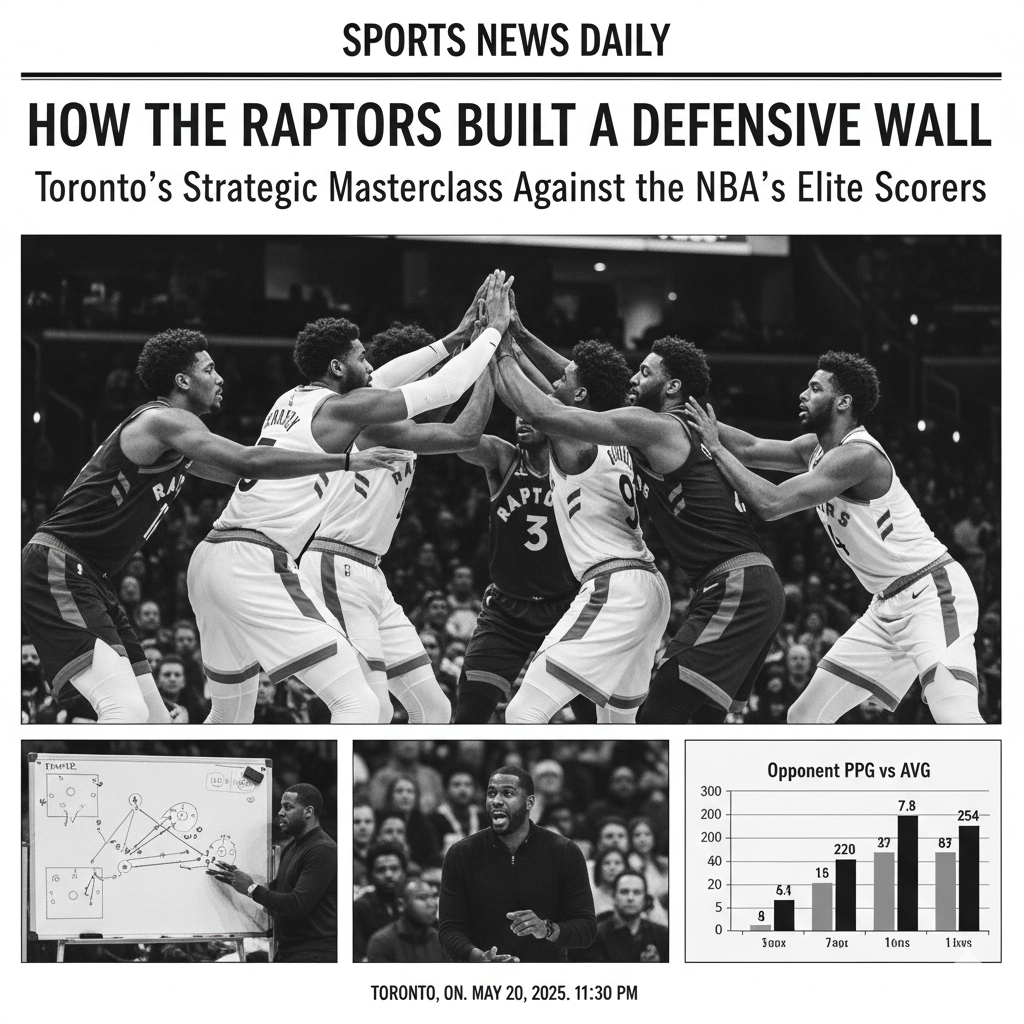
  • How the Raptors Built a Defensive Wall to Contain the NBA’s Elite Scorers

    How the Raptors Built a Defensive Wall to Contain the NBA’s Elite Scorers

    From Early Struggles to Defensive Dominance

    The Toronto Raptors entered the NBA season with questions surrounding their defensive capabilities. In the first five games, the team went 1-4, ranking 29th in defensive rating, and opponents were carving paths to the basket with alarming ease.

    Yet, in a dramatic turnaround, the Raptors have climbed to the second-best defensive rating in the league over their most recent nine games, trailing only the reigning champions from Oklahoma City. In a matter of weeks, Toronto has gone from one of the NBA’s most vulnerable defenses to one of its most formidable.

    It’s not just numbers that reflect the change—it’s moments. During their eighth win in nine games, the Raptors’ reaction to Brandon Ingram’s authoritative fourth-quarter dunk over Charlotte seven-footer Ryan Kalkbrenner captured the team’s defensive and offensive intensity. Bench players leapt to their feet in unison, jaws dropped, and teammates on the floor, like Jamal Shead, were visibly in awe.

    “Oh my goodness, that dunk was a little crazy,” Shead said after practice. “Everybody’s noticing he just looks lazy. He really isn’t lazy. He’s just tall. He got some big-ass shorts, you know? But he’s really not lazy.”

    Appearances can be deceiving, but the Raptors’ defensive turnaround is real, measurable, and strategically driven.


    The Role of Leadership and Commitment

    Scottie Barnes Sets the Tone

    Toronto’s resurgence began with a focus on defensive fundamentals and leadership from key players, particularly Scottie Barnes. Shead credits Barnes for elevating the team’s defensive standards.

    “Scottie’s playing at a first-team all-defense level,” Shead said. “He’s kind of bringing us along with him, and I’ve been trying to be right there with him.”

    Head coach Darko Rajakovic also highlighted Barnes’ influence, emphasizing how one player’s commitment can shift the culture of the team.

    “After those first three losses, we realized we had to pick up on our defense,” Rajakovic explained.


    Strategic Adjustments: Transition Defense

    The Raptors’ defensive improvement isn’t a fluke—it’s the product of systematic adjustments, particularly in transition defense. Rajakovic noted that early in the season, the team often chased offensive rebounds without the likelihood of securing second-chance points, leaving them vulnerable to fast breaks.

    “The idea is to get back and form the wall and prevent teams from scoring,” Rajakovic said. “That was our weakness to start the season. We were getting beat way too easily in the open court.”

    Toronto’s approach now prioritizes sensible defensive positioning, balancing aggressive ball pressure with the need to contain open-court attacks. The shift has been supported by players willing to embrace high-effort defensive assignments, including Jamal Shead.

    “I just told Jamal this morning, ‘What prevents you from being the best on-the-ball defender in the league? Nothing. You’ve got to own it, want it, and master your craft,’” Rajakovic said.


    Defensive Effort Meets Offensive Efficiency

    Interestingly, Toronto’s defensive focus hasn’t come at the expense of offense. As of Tuesday, the Raptors ranked eighth in offensive efficiency, demonstrating that a strong defense can complement and fuel scoring opportunities.

    “Consistently good ball pressure—disrupting ballhandlers, shortening shot clocks, and creating chaos—is only possible with players receptive to coaching and willing to put in the effort,” Rajakovic said.

    The Raptors’ young roster appears increasingly responsive and resilient, ready to execute both individual and team defensive strategies.


    Preparing for Elite Scorers: The Tyrese Maxey Test

    Toronto’s defensive evolution will face one of its toughest challenges against Tyrese Maxey of the Philadelphia 76ers. Maxey, averaging 32.5 points per game and leading the NBA in minutes played at 40 per game, represents an on-ball defensive test of the highest order.

    “He plays with a lot of pace and energy, and he can sustain that over a long period,” Rajakovic said. “You need a team effort with multiple players rotating on him over the course of the game.”

    Preparation for such matchups extends beyond physical effort. Rajakovic emphasizes the importance of film study, mastering player tendencies, and understanding league patterns.

    “It’s hard work, but also rewarding work,” he said.


    Signature Defensive Moments

    Recent games have highlighted Toronto’s defensive growth in high-pressure situations. During Monday night’s win over Charlotte, the Raptors’ defining moments came on defense:

    • Brandon Ingram blocked Ryan Kalkbrenner’s dunk with just 10 seconds remaining.

    • Scottie Barnes made a buzzer-beating block against Collin Sexton, preventing a potential overtime basket.

    These plays underscore the Raptors’ commitment to “winning plays”—defensive actions that directly influence the outcome of games. Rajakovic stresses that recognition in the NBA often favors scoring and highlight plays, but winning plays on defense are equally, if not more, impactful.

    “That’s why Scottie Barnes is so important for our team. That’s why Jamal is so important. And we have several young players trending that way,” Rajakovic said.


    Defensive Mindset and Culture

    Toronto’s defensive success is rooted not only in strategy but also in mindset. Players are encouraged to embrace defensive responsibility, understand their roles, and commit to team-oriented effort.

    For younger players like Shead, this represents an opportunity to develop into elite defenders, learning from veterans and through deliberate practice. The culture shift emphasizes that defense is as valuable as offense, and mastery of on-ball and team defensive skills can have a significant impact on the team’s trajectory.


    Conclusion: A Raptors Team Built to Withstand the League’s Best

    The Raptors’ rise from one of the NBA’s worst defenses to one of its strongest illustrates the power of leadership, strategy, and effort. By focusing on transition defense, on-ball pressure, and team cohesion, Toronto has built a defensive wall capable of challenging the league’s top scorers.

    As they prepare to face elite talents like Tyrese Maxey, the Raptors demonstrate that defensive excellence is both teachable and contagious, with younger players stepping up to match the intensity of veterans.

    “There are highlight plays, and there are winning plays,” Rajakovic said. “For us lately, the best are both.”

    With this combination of talent, effort, and coaching, Toronto’s defensive resurgence may continue to define the team’s identity throughout the season.

  • Raptors Insider: How Darko Rajakovic Is Quietly Shaping a Winning Culture in Toronto

    Raptors Insider: How Darko Rajakovic Is Quietly Shaping a Winning Culture in Toronto

    Introduction

    When the Toronto Raptors entered the season, questions swirled around whether head coach Darko Rajakovic could turn a developing roster into a winning one. His first two years with the franchise showcased strong communication skills, a positive atmosphere, and undeniable teaching abilities. But this season presented a different challenge: fewer excuses, higher expectations, and a renewed need to compete at the top level of the Eastern Conference.

    Now, nearly a quarter into the season, the answer is becoming clear. Rajakovic hasn’t changed his philosophy, demeanour, or coaching style—and that consistency has translated into wins. The Raptors are thriving not because he reinvented himself, but because he stayed true to what made him successful in the first place.

    Behind the scenes, players have bought in, the mood is lighter, and on the court, execution is sharper. Whether it’s a late-game possession or a tough road matchup, Toronto is proving it can win in multiple ways—and Rajakovic’s steady hand is at the centre of it all.


    Darko Rajakovic’s Philosophy: Teaching, Positivity, and Trust

    A Coach True to His Roots

    One of the most striking themes that emerges from speaking with Raptors players is that Rajakovic has remained exactly the same coach he has always been. Despite the pressure to move beyond the “rebuilding” phase, his style hasn’t shifted toward harsh criticism or demanding theatrics. Instead, his approach continues to revolve around teaching in real time, correcting mistakes through dialogue, and building trust.

    Players universally say that they appreciate the way he handles in-game coaching. Instead of berating players or calling them out publicly, Rajakovic communicates directly, clearly, and respectfully—even during the heat of live play.

    Positivity That Resonates

    It’s rare in the NBA to find a coach who refrains from publicly criticizing his players. Rajakovic has mastered that balance. While he may privately acknowledge flaws that fans or analysts see, he never places his players in uncomfortable situations by going negative on the record.

    Over more than two seasons of covering the team, it’s difficult to recall a single instance where he publicly chastised a player. This matters more than many realize. Players know he supports them, and they respond with effort and engagement. As RJ Barrett put it earlier this week:
    “Darko? Man, he cares about us. Of course we want to play for him.”

    Beyond tactics and film sessions, Rajakovic also fosters personal connection. His daily check-ins about life off the court, the post-game “chain” award, and his approachable personality have contributed to an atmosphere where players genuinely enjoy showing up to work.


    Tactical Growth: Trusting Players to Execute

    Winning the Tough Ones

    Critics once wondered whether Rajakovic’s strengths—his people skills, developmental focus, and positivity—would ultimately translate to winning in pressure moments. So far, he’s answered that doubt convincingly.

    In the Raptors’ recent victories, which were decided in the final minutes, the difference-maker wasn’t a series of dramatic sideline play calls. Instead, it was player execution—something Rajakovic has prepared them for since training camp.

    He does not rely on an elaborate collection of “end-of-game plays,” nor does he feel compelled to micromanage. Rather, he trusts players to read the situation, react appropriately, and make the correct basketball decision. That trust empowers players to take ownership of clutch moments, and they love him for it.

    A Style That Translates

    Inside the organization, some had wondered over the past two seasons whether Rajakovic’s coaching identity—rooted in chemistry building and teaching—could pivot to the demands of a team expected to win now. Although the sample size remains early, the answer so far is a resounding yes. Toronto is playing harder, smarter, and more cohesively than many expected, and the coaching staff’s belief in player autonomy is paying off.


    Ja’Kobe Walter Finds His Groove

    A Rocky Start to the Season

    Through the first 10 to 12 games of the season, one of the biggest questions lingering around the Raptors’ rotation was: Why isn’t Ja’Kobe Walter better yet?
    The talented young guard has all the tools—speed, shooting touch, confidence—but for weeks he struggled to find rhythm or carve out meaningful minutes.

    Coaches and players couldn’t pinpoint a specific issue. Each offered a different, partial explanation:

    • “Maybe it’s his balance?”

    • “He probably needs to get stronger.”

    • “There’s no real reason.”

    A Promising Breakthrough

    Whatever the cause, Walter appears to have turned a corner. His recent performances have given the Raptors a noticeable boost. His best outing came Wednesday in Philadelphia, where he delivered 11 points, drained three three-pointers, recorded three steals, and held his own defensively against Tyrese Maxey—no small task.

    This followed an impressive defensive showing in Cleveland, suggesting his confidence is no longer fluctuating from game to game.

    If Walter can maintain this upward trajectory, Toronto suddenly has a bench unit that stretches five deep—immensely valuable over an 82-game season. A more reliable second unit also reduces the burden on the starters and opens up new lineup possibilities.

    Of course, consistency is key. Walter will need to prove he can play at this level night after night. But compared to where he was during the early-season slump, the organization’s optimism has grown significantly.


    Jamison Battle: Preparing the Mind as Much as the Body

    The Mental Edge Behind His Readiness

    Raptors forward Jamison Battle may not be the first name mentioned when discussing breakout candidates, but his preparation—both physical and mental—has made him a dependable contributor whenever called upon.

    During a conversation near the end of the team’s recent road trip, Battle offered rare insight into how he stays ready. Beyond maintaining peak physical shape, he places strong emphasis on maintaining a steady, balanced mental state.

    He credits much of this mindset to the work of Trevor Moawad, a renowned mental performance coach who helped elite athletes across multiple sports.

    Neutral Mindset in Action

    Battle referenced Moawad’s books, Getting to Neutral and It Takes What It Takes, which emphasize staying emotionally centered—neither too high after a great game nor too low after a rough one.

    “It’s like being in neutral in a car,” Battle explained. “You’re ready to go forward, but you’re also ready to go backwards, and you only want to stay in the present moment.”

    This type of introspective approach is rare among professional athletes, and it highlights Battle’s maturity as well as the seriousness with which he prepares for his role. His willingness to train both the body and the mind gives fans yet another reason to appreciate the depth and professionalism developing within this Raptors team.


    Conclusion

    The Raptors entered the season facing uncertainty—from the growth of young players to the expectations placed on Darko Rajakovic. But through stability, trust, and an unwavering commitment to his core values, Rajakovic has guided the team into a new phase of competitive basketball.

    Wins are stacking up, players are thriving under his leadership, and the culture in Toronto feels rejuvenated. While it’s still early and much of the season lies ahead, the foundation now looks stronger than ever.

  • Inside a Tumultuous Era for Canada Basketball: Raptors Roots, Controversy, and Allegations of Racism

    Inside a Tumultuous Era for Canada Basketball: Raptors Roots, Controversy, and Allegations of Racism

    Canada’s basketball story is one of ambition, turbulence, and transformation. From a sport once on the margins of national attention to a rising powerhouse producing global stars, the journey has been marked by triumphs, missteps, and deep structural challenges. Toronto-based journalist Oren Weisfeld’s new book, “The Golden Generation: How Canada Became a Basketball Powerhouse,” provides a vivid account of this evolution, highlighting pivotal moments, behind-the-scenes struggles, and the individuals who shaped the game’s growth in Canada.

    The 1994 FIBA World Championship: Canada’s Moment on the Global Stage

    Originally slated for Belgrade, Serbia, the 1994 FIBA World Championship faced a last-minute relocation after civil unrest in Yugoslavia. In 1991, a violent civil war forced the International Basketball Federation (FIBA) to reopen the bidding process for a new host. Boris Stankovic, then head of FIBA, reached out to Canadian businessman John Bitove, asking if Canada could step in.

    Securing the NBA Connection

    Bitove recognized that hosting the championship would only make sense if NBA players were allowed to participate. Professional athletes brought not only elite talent but also massive marketing potential, especially following the global success of the 1992 Barcelona Olympics, where the U.S. Dream Team—featuring Michael Jordan, Magic Johnson, Larry Bird, and Charles Barkley—dominated both on and off the court.

    To secure NBA participation, Bitove called NBA commissioner David Stern, who reportedly told him:

    “Listen, young man, I don’t know you, but I do know Canada, and I know Toronto. And the only way we would allow the pros to play in the world championship is if it’s in North America.”

    This approval set the stage for Canada to host an 11-day tournament across Toronto’s SkyDome, Maple Leaf Gardens, and Hamilton’s Copps Coliseum. With $13 million raised and unprecedented organizational effort, Canada Basketball broke attendance records, selling 332,334 tickets, including 32,000 to the gold medal game at SkyDome. The event not only broke even financially but also secured 40% of profits for Canada Basketball, helping stabilize an organization on the brink of collapse.

    The Birth of the Toronto Raptors

    The championship’s success provided a springboard for Bitove to pursue an NBA franchise. In 1993, leveraging the contacts and momentum from hosting the FIBA tournament, he became the owner of Toronto’s first NBA team—the Raptors. Reflecting on the connection, Bitove noted, “Without the ’94 worlds, I wouldn’t have had the NBA team.”

    Steve Nash Emerges on the International Stage

    For Canadian basketball fans, the tournament also marked the international debut of a future star. At just 20 years old, Steve Nash made his first appearance with Canada’s senior team. In 23 minutes per game, he averaged seven points, three assists, three rebounds, and two steals.

    Bitove recalled the team’s challenges:

    “We spent all of our time trying to get (Canada’s lone NBA player) Rick Fox freed up to play. Lo and behold, Steve Nash stole the show.”

    Despite Nash’s emergence, Canada’s performance fell short. The team finished seventh among 16 participants, failing to advance past their group after losses to Russia and Greece. Team USA, led by Shaquille O’Neal, captured the gold medal with dominant victories, underscoring the gap between Canada and the world’s elite at that time.

    Mixed Fan Support

    While arenas were full, many spectators supported opposing teams rather than Canada. One particularly jarring game against Greece featured more Greek flags than Canadian ones, prompting a public rebuke from Hockey Night in Canada commentator Don Cherry. Nash reflected on the scene:

    “Back then basketball was a little bit more of a niche sport. Fans from those nations were coming out to support the countries against Canada.”

    Toronto, Montreal, and Hamilton’s diverse immigrant populations shaped this dynamic, demonstrating intense patriotism that often sidelined homegrown Canadian support. Doug Smith, a Toronto Star reporter, described the event as “one of the most embarrassing sports events I’ve ever been at.”

    A National Team in Transition

    Before the arrival of the Raptors and Vancouver Grizzlies in 1995, Canadian basketball lacked mainstream recognition. Former Team Canada captain Leo Rautins recalled, “Nobody ever saw us play.” Stars like Jay Triano and Eli Pasquale were celebrated abroad but largely ignored at home, highlighting the disconnect between international and domestic recognition.

    Despite having notable talent—NBA player Rick Fox, overseas pros like Greg Wiltjer, Martin Keane, Joey Vickery, Dwight Walton, and the young Nash—Canada struggled against top-tier opponents. The team’s slow, methodical style, focused on discipline over flair, was less appealing to spectators accustomed to fast-paced, high-scoring games.

    Ken Shields’ Centralized Program

    Head coach Ken Shields, who assumed leadership in 1989, centralized training in Victoria, British Columbia, utilizing his connections to secure year-round facilities, apparel sponsorships, and accommodations. His approach focused on developing amateur athletes from U Sports programs, especially University of Victoria players, emphasizing fitness, execution, and team cohesion over speed or individual skill.

    Assistant coach Eddie Pomykala candidly noted:

    “Let’s be honest: the national teams were white teams.”

    While Shields’ methods produced some professional-level talent and national team selections, the balance of basketball power in Canada was shifting eastward, toward multicultural cities like Toronto and Montreal. These urban centers became dominant in high school and provincial competitions, regularly supplying athletes to the NCAA and professional leagues for the first time in Canadian history.

    Allegations of Racism and Structural Barriers

    The composition of national teams reflected broader issues within Canadian basketball. With few Black players on rosters, systemic biases and limited pathways for diverse athletes were evident. While Shields’ program succeeded in producing skilled, disciplined athletes, it often overlooked emerging talent from metropolitan, immigrant-rich regions.

    This tension underscored ongoing challenges in Canadian basketball: integrating talent equitably, cultivating fan engagement, and building a program capable of competing internationally while reflecting the nation’s diversity.

    Conclusion: Foundations for the Future

    The 1994 FIBA World Championship marked a pivotal moment for Canadian basketball, catalyzing the growth of professional infrastructure, international exposure, and future stars like Steve Nash. Yet it also revealed structural weaknesses, limited domestic support, and racial disparities that would shape the sport’s evolution.

    Weisfeld’s “The Golden Generation” captures this complexity, detailing a period when Canada began its transformation from an underappreciated basketball nation to a rising global presence, laying the groundwork for the success and inclusivity the country now seeks to achieve in the sport.